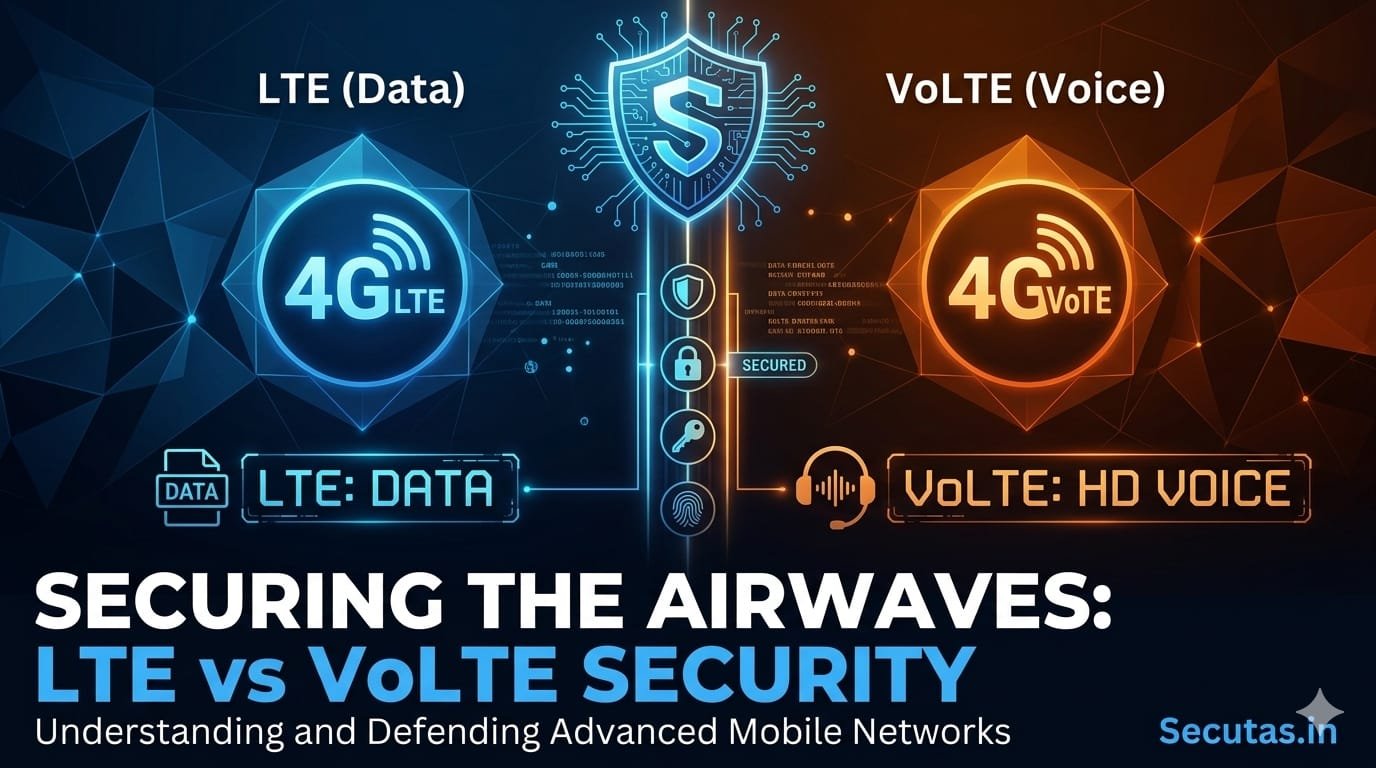
In the modern telecommunications landscape, we often take the 4G or “LTE” symbol at the top of our screens for granted. It represents speed, connectivity, and the ability to stream high-definition content on the go. However, as we transition into an era where voice is no longer a separate circuit but just another stream of data—VoLTE—the security implications shift from traditional telephony risks to complex cyber-system vulnerabilities.
At Secutas, we believe that understanding the architecture of your connectivity is the first step in defending it. Here is everything you need to know about LTE, VoLTE, and the security protocols keeping your data safe.
1. LTE vs. VoLTE: The Shift to All-IP
To understand the security, we must first understand the tech.
- LTE (Long-Term Evolution): When LTE first launched, it was designed as a “data-only” pipe. Because it was an All-IP (Internet Protocol) network, it didn’t naturally support the old way of making phone calls. In the early days, when you hit “dial,” your phone would perform a Circuit Switched Fallback (CSFB), essentially dropping down to 3G or 2G just to handle the call.
- VoLTE (Voice over LTE): VoLTE changed the game by allowing voice to be carried as data packets over the LTE network. It utilizes the IP Multimedia Subsystem (IMS) to manage these calls. This means you get “HD Voice,” faster call setups, and the ability to use high-speed 4G data while simultaneously talking on the phone.
2. The Security Framework: How Your Data is Shielded
Because LTE and VoLTE are IP-based, they don’t rely on the physical security of a wire. Instead, they use a sophisticated “Evolved Packet Core” (EPC) to manage security through several layers:
Mutual Authentication (The AKA Protocol)
Unlike older 2G networks, where only the phone had to prove itself to the tower, LTE uses the Authentication and Key Agreement (AKA). This ensures mutual authentication: your phone proves it’s yours, and the network proves it’s a legitimate carrier and not a malicious “rogue base station.”
Signaling and User Plane Encryption
- Control Plane: The “instructions” sent between your phone and the tower are encrypted to prevent attackers from seeing who you are calling or where you are located.
- User Plane: Your actual data (browsing, videos) is encrypted, typically using AES (Advanced Encryption Standard) or SNOW 3G algorithms.
VoLTE Specifics: IPSec Tunnels
Because VoLTE is essentially a VoIP service running over a mobile network, it adds an extra layer of protection. It often employs IPSec (Internet Protocol Security) tunnels between the user’s device and the IMS entry point. This acts as a secure “vault” for your voice packets as they travel through the network.
3. The “Secutas” Perspective: Emerging Vulnerabilities
As an IP-based system, LTE/VoLTE faces threats that look less like “wiretapping” and more like “hacking.”
- Downgrade Attacks: Sophisticated attackers use “IMSI Catchers” (Stingrays) to jam 4G signals, forcing a phone to “downgrade” to 2G. Since 2G has weak encryption and no mutual authentication, the attacker can then intercept calls and SMS.
- SIP-Based Attacks: VoLTE relies on SIP (Session Initiation Protocol). This opens the door to vulnerabilities like SIP Invite flooding (a form of DDoS) or header manipulation, which could lead to caller ID spoofing or unauthorized access to services.
- Permissions & Side Channels: Research has shown that sometimes the way an OS handles VoLTE allows malicious apps to “silently” initiate calls or bypass certain billing protections if the IMS stack isn’t properly isolated.
4. Security Comparison Table
| Security Feature | LTE (Data) | VoLTE (Voice) |
|---|---|---|
| Primary Protection | Network Layer Encryption | Application Layer (IMS) + Network Layer |
| Authentication | USIM-based Mutual AKA | Dual-layer (Network + IMS Auth) |
| Key Threat | Rogue Base Stations (2G Fallback) | SIP Hijacking / DDoS |
| Encryption Standard | 128-bit AES / SNOW 3G | IPSec Tunnels for Signaling |
Conclusion
The transition to VoLTE has made our communication clearer and more efficient, but it has also moved the “battlefield” of mobile security into the realm of IP networking. For organizations and individuals alike, staying secure means ensuring devices are updated to patch IMS vulnerabilities and being aware of the risks associated with signal downgrading.
At Secutas, we are dedicated to staying ahead of these telecom transitions. Security isn’t just a feature; it’s the foundation of every connection we make.
Stay Connected. Stay Secure.
For more technical deep-dives and GRC insights, visit the Secutas Website
Leave a Reply