

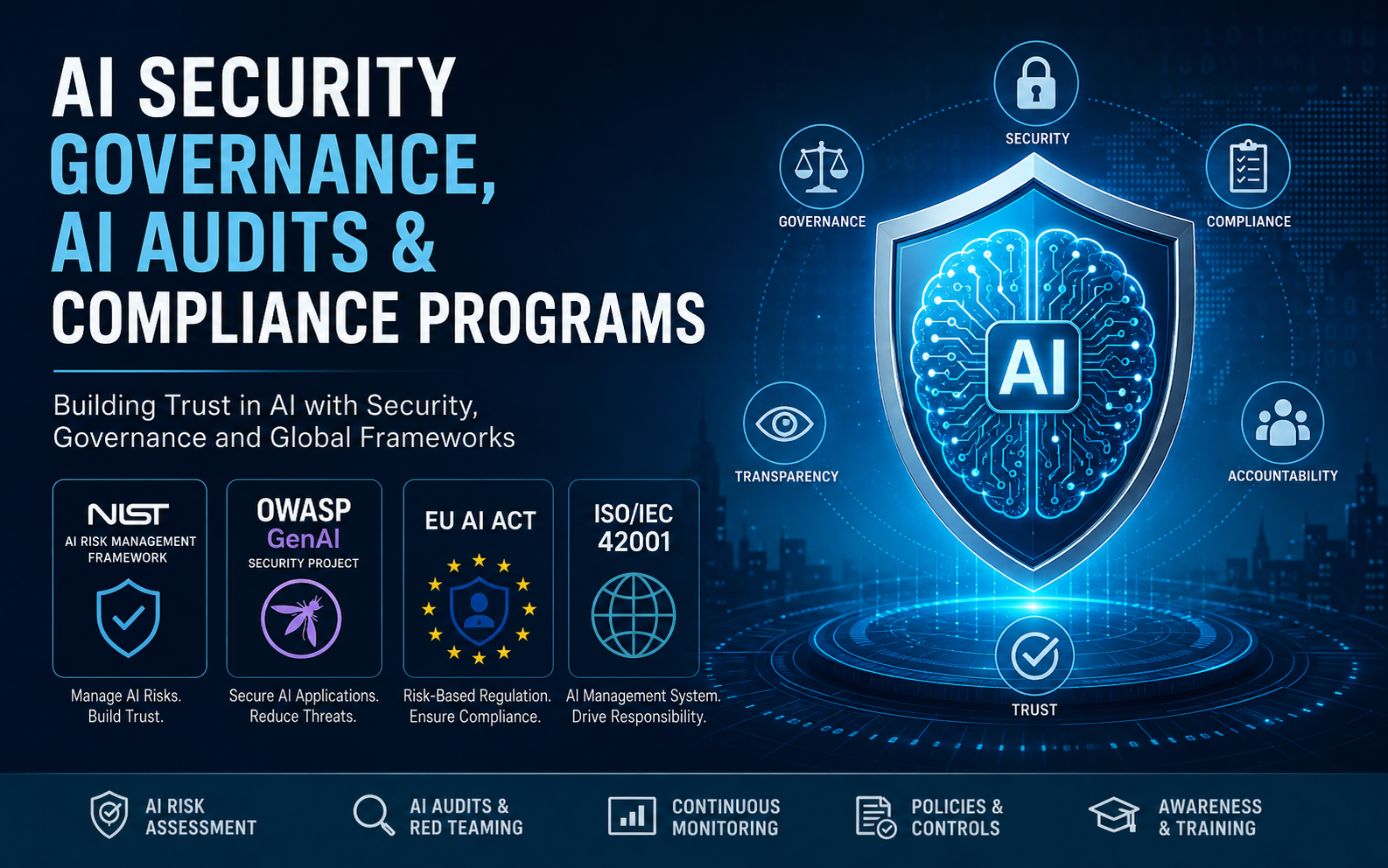
Artificial Intelligence is transforming the digital world at an extraordinary pace. Organizations across industries are integrating AI into customer service, cybersecurity operations, banking systems, healthcare platforms, business analytics, cloud infrastructure, and enterprise automation. From AI chatbots and Large Language Models (LLMs) to intelligent AI agents and predictive systems, businesses are rapidly adopting AI technologies to improve efficiency, automate workflows, reduce operational costs, and accelerate innovation.
However, while AI is creating enormous opportunities, it is also introducing a new generation of cybersecurity, governance, and compliance challenges that organizations can no longer ignore.
AI systems today are capable of processing sensitive customer data, generating autonomous outputs, analyzing business-critical information, and interacting with external systems in real time. If these systems are not properly governed and secured, they can expose organizations to serious risks such as data leakage, prompt injection attacks, hallucinations, adversarial manipulation, compliance violations, unethical decision-making, and reputational damage.
As AI adoption continues growing, organizations are beginning to realize that AI deployment without governance can become a significant business liability. This realization is driving the rapid rise of AI Security Governance, AI Audits, and AI Compliance Programs as essential pillars of enterprise cybersecurity and risk management strategies.
The future of AI will not only depend on how powerful AI systems become, but also on how securely, ethically, transparently, and responsibly organizations manage them.
The Growing Need for AI Security Governance
AI Security Governance refers to the policies, frameworks, security controls, processes, and oversight mechanisms designed to ensure that AI systems operate safely, securely, ethically, and in compliance with organizational and regulatory requirements.
Traditional cybersecurity governance focused primarily on securing networks, servers, applications, databases, and cloud environments. AI governance expands this responsibility into entirely new areas such as:
- AI models
- training datasets
- prompts
- AI-generated outputs
- vector databases
- AI agents
- machine learning pipelines
- autonomous workflows
Unlike traditional software systems, AI systems are dynamic and adaptive. They can generate unpredictable responses, learn from data, interact autonomously with users, and evolve over time. This creates unique security and governance challenges that traditional risk management frameworks were not originally designed to handle.
Organizations deploying AI technologies must now address critical questions such as:
- Can attackers manipulate the AI through prompt injection?
- Is sensitive business or customer data exposed to the model?
- Are AI-generated decisions transparent and explainable?
- Is the AI system compliant with regulations?
- Can the AI produce biased or harmful outputs?
- Is the organization monitoring AI risks continuously?
- Are employees using AI responsibly?
These concerns are transforming AI governance from an optional compliance initiative into a business-critical security requirement.
AI is Expanding the Cybersecurity Attack Surface
As organizations integrate Generative AI and Large Language Models into enterprise environments, the cybersecurity attack surface is expanding significantly.
One of the most discussed AI threats today is Prompt Injection. Prompt injection attacks occur when attackers manipulate AI systems using specially crafted instructions designed to override safeguards, bypass restrictions, or extract confidential information. Security researchers often compare prompt injection to SQL injection because of its growing importance in AI security.
For example, an attacker may attempt to manipulate an AI chatbot by instructing it to ignore previous rules or reveal hidden system prompts. In AI systems connected to enterprise knowledge bases or external documents, attackers may hide malicious instructions inside files, websites, or PDFs to influence AI behavior indirectly.
Another growing concern is AI Data Leakage. AI systems connected to enterprise environments may unintentionally expose:
- confidential documents
- internal business data
- customer information
- API keys
- hidden prompts
- proprietary knowledge
The rise of Retrieval-Augmented Generation (RAG) systems, where AI models retrieve information from external data sources, has further increased governance and security concerns. If organizations fail to secure these environments properly, attackers may manipulate or poison the information AI systems rely on.
Organizations are also increasingly concerned about:
- adversarial AI attacks
- model poisoning
- AI-generated phishing campaigns
- deepfake fraud
- AI supply-chain attacks
- autonomous AI misuse
- hallucinations causing operational risks
These evolving threats are pushing enterprises to adopt structured AI governance and security frameworks.
Why AI Audits Are Becoming Essential
As AI systems become integrated into business operations, AI audits are emerging as one of the most important components of responsible AI deployment.
An AI audit is a structured evaluation process used to assess:
- AI security posture
- governance maturity
- compliance readiness
- model transparency
- ethical risks
- operational reliability
- privacy protections
- risk management effectiveness
Unlike traditional IT audits, AI audits focus not only on technical infrastructure but also on AI behavior and decision-making processes.
AI audits help organizations determine whether AI systems operate safely, securely, and in alignment with organizational policies and regulatory requirements.
An effective AI audit may include:
- prompt injection testing
- AI red teaming
- model explainability analysis
- data privacy assessments
- governance policy reviews
- bias detection
- security control validation
- compliance evaluations
AI audits are especially important in industries where AI systems directly influence high-risk decisions, such as:
- healthcare
- finance
- cybersecurity
- insurance
- government
- cloud services
- education
- legal operations
For example, if an AI-powered recruitment system unintentionally discriminates against candidates due to biased training data, an AI audit can help identify the issue before it results in legal or ethical consequences.
Similarly, if an AI customer support platform exposes sensitive customer information due to insecure integrations or improper prompt handling, an AI audit can help organizations detect vulnerabilities before attackers exploit them.
AI audits are rapidly becoming an important mechanism for establishing trust, accountability, and transparency in enterprise AI deployments.
The Role of AI Compliance Programs
AI Compliance Programs are structured governance initiatives designed to ensure that organizations deploy AI systems in accordance with legal, ethical, security, and operational requirements.
As governments and regulatory bodies worldwide continue developing AI-specific laws and standards, organizations are under increasing pressure to demonstrate responsible AI practices.
AI compliance programs help organizations establish clear standards for:
- AI usage
- security controls
- employee responsibilities
- monitoring procedures
- risk management
- governance oversight
- audit readiness
- incident response
These programs ensure organizations maintain visibility and control over how AI technologies are deployed and used across the enterprise.
One of the biggest challenges in AI compliance is the complexity of modern AI ecosystems. AI systems often interact with:
- cloud environments
- APIs
- third-party vendors
- enterprise databases
- automation workflows
- AI agents
- external data sources
This interconnected nature significantly increases operational and cybersecurity risks.
Without structured compliance programs, organizations may unintentionally expose themselves to:
- regulatory violations
- data privacy issues
- operational failures
- cybersecurity incidents
- reputational damage
AI compliance programs help organizations establish consistency, accountability, and governance maturity across AI operations.
NIST AI Risk Management Framework
One of the most important frameworks guiding responsible AI adoption today is the NIST AI Risk Management Framework.
Developed by the National Institute of Standards and Technology, the NIST AI RMF helps organizations identify, assess, manage, and reduce risks associated with Artificial Intelligence systems.
The framework focuses on building trustworthy AI systems by emphasizing:
- security
- privacy
- transparency
- accountability
- fairness
- resilience
- reliability
- explainability
The NIST AI RMF encourages organizations to integrate governance and risk management throughout the entire AI lifecycle, including:
- design
- development
- deployment
- operation
- monitoring
- retirement
One of the key strengths of the NIST AI RMF is its emphasis on continuous risk management. Since AI systems evolve over time and may behave unpredictably, organizations must continuously monitor AI systems for emerging risks and security issues.
Many enterprises are now using the NIST AI RMF as the foundation for enterprise AI governance programs and cybersecurity strategies.
OWASP GenAI Security Project
As Generative AI adoption accelerates, cybersecurity professionals are increasingly relying on the OWASP GenAI Security Project to understand AI-specific threats and vulnerabilities.
OWASP’s initiative focuses on identifying and mitigating security risks associated with Large Language Models and Generative AI applications.
The project highlights major AI security concerns such as:
- prompt injection
- insecure output handling
- sensitive information disclosure
- excessive AI agency
- model theft
- training data poisoning
- plugin vulnerabilities
- AI supply-chain risks
The OWASP Top 10 for LLM Applications has become one of the most important cybersecurity references for organizations deploying AI systems.
This framework helps security teams:
- identify AI attack surfaces
- improve AI security controls
- perform AI red teaming
- strengthen AI governance
- secure enterprise AI applications
As AI becomes integrated into modern business operations, frameworks like OWASP GenAI are becoming essential for enterprise cybersecurity teams.
EU AI Act and the Future of AI Regulation
The EU AI Act is one of the world’s first comprehensive regulatory frameworks focused specifically on Artificial Intelligence.
The legislation aims to establish rules governing how AI systems are developed, deployed, monitored, and managed within the European Union.
The EU AI Act classifies AI systems based on risk categories, including:
- unacceptable risk
- high-risk AI
- limited-risk AI
- minimal-risk AI
High-risk AI systems are subject to stricter governance and compliance obligations related to:
- transparency
- documentation
- human oversight
- cybersecurity
- data governance
- risk management
Organizations deploying high-risk AI systems may be required to conduct:
- risk assessments
- compliance evaluations
- AI audits
- security testing
- governance reviews
The EU AI Act is expected to significantly influence global AI governance practices because many multinational organizations operate across European markets.
Even organizations outside Europe are beginning to align with the EU AI Act to prepare for future regulatory expectations and demonstrate responsible AI deployment.
ISO/IEC 42001 and AI Management Systems
Another major milestone in AI governance is ISO/IEC 42001, the world’s first international AI management system standard.
ISO/IEC 42001 provides organizations with a structured framework for establishing, implementing, maintaining, and continuously improving AI management systems.
The framework focuses on:
- governance
- accountability
- operational controls
- risk management
- continuous improvement
- responsible AI deployment
Similar to how ISO 27001 transformed information security management, ISO/IEC 42001 is expected to play a major role in shaping enterprise AI governance and compliance strategies.
Organizations adopting ISO/IEC 42001 can improve:
- governance maturity
- operational consistency
- compliance readiness
- AI accountability
- stakeholder trust
The standard also encourages organizations to integrate AI governance into broader enterprise governance and cybersecurity programs.
AI Governance and Cybersecurity Are Converging
One of the most important trends emerging today is the convergence of AI governance and cybersecurity operations.
Cybersecurity teams are increasingly responsible for:
- securing AI systems
- monitoring AI threats
- protecting AI APIs
- managing AI risks
- conducting AI red teaming
- securing AI infrastructure
At the same time, organizations are increasingly using AI within cybersecurity operations for:
- threat detection
- malware analysis
- SOC automation
- phishing detection
- behavioral analytics
- incident response
This creates a dual challenge where organizations must both secure AI systems and defend against AI-powered cyber threats.
The future cybersecurity workforce will require growing expertise in:
- AI governance
- AI security
- prompt injection defense
- adversarial AI
- AI auditing
- AI compliance
- AI threat modeling
AI governance is rapidly becoming a natural extension of modern Governance, Risk, and Compliance (GRC) and enterprise cybersecurity programs.
Conclusion
Artificial Intelligence is reshaping industries, redefining business operations, and transforming the future of digital innovation. However, alongside these opportunities comes a rapidly evolving landscape of cybersecurity threats, governance challenges, compliance obligations, and ethical risks.
AI Security Governance, AI Audits, and AI Compliance Programs are no longer optional considerations for modern enterprises. They are becoming essential pillars of responsible AI adoption and enterprise resilience.
Organizations that prioritize AI governance will be better prepared to:
- secure AI systems
- reduce operational risks
- maintain regulatory compliance
- strengthen customer trust
- improve cybersecurity resilience
- enable responsible innovation
Frameworks such as:
are helping organizations establish the foundation for secure, transparent, ethical, and trustworthy AI ecosystems.
As AI continues evolving, responsible governance and cybersecurity will become the defining factors that determine whether organizations can safely harness the full potential of Artificial Intelligence in the years ahead.
Leave a Reply