

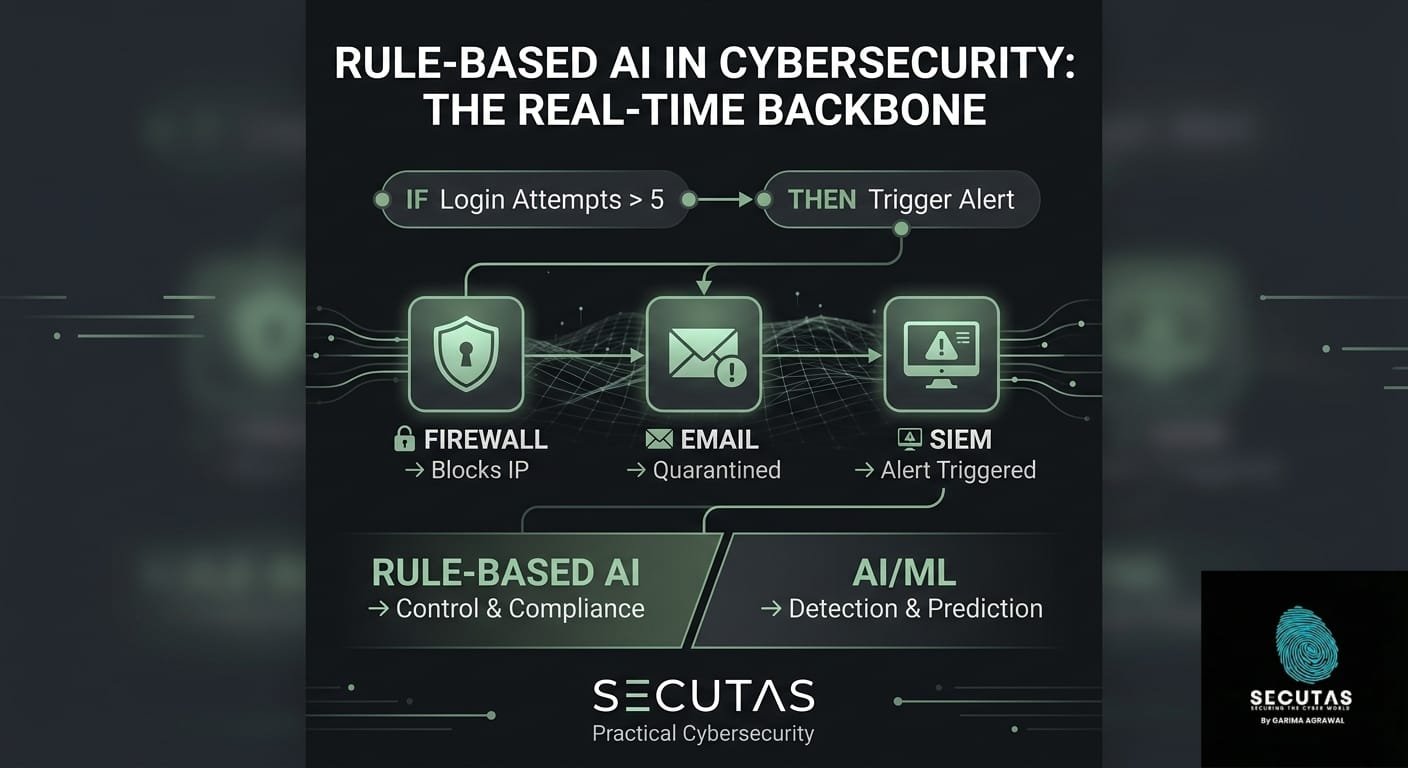
Artificial Intelligence has become one of the most talked-about forces shaping modern cybersecurity. From advanced threat detection systems to predictive analytics and behavioral monitoring, the narrative is often dominated by machine learning models and data-driven intelligence. However, beneath this wave of innovation lies a foundational approach that continues to power critical security mechanisms across organizations worldwide—rule-based AI.
While it may not carry the same buzz as deep learning or neural networks, rule-based AI remains one of the most reliable, transparent, and operationally efficient methods for enforcing security controls. In fact, before organizations adopt complex AI-driven systems, they almost always begin with rule-based architectures to establish baseline protection, compliance enforcement, and deterministic decision-making.
This blog provides a comprehensive and practical understanding of rule-based AI in cybersecurity. More importantly, it walks you through how to design and build your own rule-based security system from scratch—without relying on machine learning.
🔍 Understanding Rule-Based AI
At its core, rule-based AI is a form of artificial intelligence that operates on explicitly defined logic. These systems follow a simple but powerful structure:
IF (condition) → THEN (action)
Each rule represents a piece of expert knowledge encoded into the system. These rules are manually crafted by security professionals based on known threats, organizational policies, and expected system behavior.
Unlike machine learning models that infer patterns from large datasets, rule-based systems rely on human-defined logic. This makes them highly interpretable and predictable—two characteristics that are extremely valuable in cybersecurity environments where accountability and traceability are essential.
For example, consider a simple rule:
IF a user fails login more than five times within two minutes → THEN trigger an alert
This rule does not require any training data or statistical modeling. It is based purely on domain knowledge of what constitutes suspicious behavior.
🧠 How Rule-Based AI Works
A rule-based security system operates through a structured pipeline that processes incoming data and evaluates it against predefined conditions. The workflow can be broken down into four key stages.
First, the system collects input data from various sources. This may include authentication logs, network traffic, endpoint activity, or application-level events. These data points form the raw material that the system analyzes.
Next comes rule evaluation. Each incoming event is checked against a set of predefined rules stored within the system. These rules act as filters or conditions that determine whether a particular behavior is normal or suspicious.
Once a rule condition is satisfied, the system moves into the decision-making phase. Here, it determines the appropriate action based on the rule definition. This could involve generating an alert, blocking access, logging an incident, or triggering an automated response.
Finally, the output is produced. This output is typically in the form of alerts, logs, notifications, or enforcement actions that help security teams respond to potential threats.
This entire process happens in real time, making rule-based systems highly efficient for operational security environments.
📌 Real-World Applications
Rule-based AI is not a theoretical concept—it is deeply embedded in many of the security tools organizations use daily.
Security Information and Event Management (SIEM) systems rely heavily on rules to correlate events and detect suspicious activity. Firewalls use rule sets to allow or block network traffic based on IP addresses, ports, and protocols. Intrusion Detection Systems (IDS) monitor network behavior using predefined signatures and rules. Even Governance, Risk, and Compliance (GRC) platforms use rule-based logic to enforce policies and ensure regulatory adherence.
For instance:
IF an IP address is on a blacklist → Block access
IF an email contains an executable attachment → Quarantine it
IF a login occurs outside business hours → Flag the activity
These examples demonstrate how rule-based systems form the backbone of operational cybersecurity.
🛡️ Why Rule-Based AI Still Matters
Despite the rapid advancement of machine learning, rule-based AI continues to play a critical role in cybersecurity for several reasons.
One of the most important advantages is explainability. Every decision made by a rule-based system can be traced back to a specific rule. This level of transparency is essential for audits, compliance checks, and incident investigations. Security teams can clearly explain why a particular action was taken, which is often not possible with black-box machine learning models.
Another key benefit is deterministic behavior. Rule-based systems produce consistent outputs for the same inputs. This predictability is crucial in security operations, where inconsistent behavior can lead to vulnerabilities or false positives.
Performance is another strong point. Rule evaluation is computationally lightweight and does not require training or inference phases. This allows for real-time detection and response without significant resource overhead.
Perhaps most importantly, rule-based systems align naturally with GRC frameworks. Standards such as ISO 27001, NIST, and SOC 2 require organizations to implement clearly defined controls, enforce policies, and maintain audit trails. Rule-based systems are inherently designed to meet these requirements, making them indispensable in compliance-driven environments.
⚙️ Core Components of a Rule-Based Security System
To build your own rule-based system, it is important to understand its architecture. A typical system consists of four main components.
The input layer is responsible for data collection. This layer gathers information from various sources such as login attempts, system logs, network traffic, and application events. The quality and structure of this data are critical for accurate rule evaluation.
The rule engine serves as the brain of the system. It contains all the predefined rules, each consisting of a condition and an associated action. Rules may also include metadata such as severity levels and categories.
The processing engine handles the evaluation logic. It processes incoming data, applies rules, manages thresholds, and maintains time windows for detecting patterns such as repeated login attempts.
Finally, the output layer manages responses. When a rule is triggered, this layer generates alerts, logs incidents, blocks access, or notifies administrators.
🛠️ Building Your Own Rule-Based Security System
Let’s move from theory to implementation by building a simple rule-based system for detecting brute-force login attempts.
The first step is to define your use case. In this case, we want to detect multiple failed login attempts from the same IP address within a short time frame.
Next, we design the data structure. Logs should be structured in a consistent format such as JSON, containing fields like IP address, status, and timestamp.
Once the data structure is in place, we implement the rule engine using Python. The system tracks failed login attempts for each IP address and checks whether they exceed a predefined threshold within a specified time window.
The logic involves maintaining a time-based list of failed attempts and filtering out entries that fall outside the time window. When the threshold is exceeded, an alert is triggered.
After implementing the rule engine, the next step is to simulate real data. By feeding sample logs into the system, you can validate whether the rule correctly detects suspicious behavior.
This simple project demonstrates how powerful rule-based systems can be, even without machine learning.
🔄 Expanding Your System
Once the basic system is operational, you can extend it by adding more rules to cover a wider range of security scenarios.
You can implement suspicious login detection by flagging logins from new geographic locations. Email threat detection can be added by identifying and quarantining executable attachments. Blacklist enforcement can block known malicious IP addresses. Time-based rules can flag activities that occur outside normal business hours.
As you add more rules, your system evolves into a comprehensive security monitoring solution.
📊 From Project to Product
To transform your system into a usable product, you need to focus on usability and scalability.
One of the first enhancements is building a dashboard using frameworks like Flask or Streamlit. This allows users to upload logs, view alerts, and visualize attack patterns in an intuitive interface.
Adding a rule editor can significantly improve flexibility. Users should be able to create, modify, and manage rules without modifying the underlying code. This makes the system more accessible to non-technical users.
Integrating GRC capabilities can further increase the value of your system. By mapping rules to standards such as ISO 27001 or NIST, you can turn your project into a compliance automation tool. This is particularly useful for organizations that need to demonstrate adherence to regulatory requirements.
⚠️ Limitations of Rule-Based AI
While rule-based systems are powerful, they are not without limitations.
One major drawback is their inability to detect unknown threats. Since rules are predefined, the system can only identify patterns that have already been defined. This makes it less effective against zero-day attacks or novel threat vectors.
Another challenge is maintenance. Rules need to be continuously updated as new threats emerge. This requires ongoing effort from security teams.
Additionally, rule-based systems can be predictable. If attackers understand the rules, they may find ways to bypass them by slightly modifying their behavior.
🔥 Rule-Based AI vs Machine Learning
Rule-based AI and machine learning serve different purposes in cybersecurity.
Rule-based systems excel at control and enforcement. They are ideal for implementing policies, ensuring compliance, and handling well-defined scenarios.
Machine learning, on the other hand, is better suited for detection and prediction. It can identify patterns and anomalies that are not explicitly defined.
Rather than choosing one over the other, modern cybersecurity strategies combine both approaches. Rule-based systems provide reliability and transparency, while machine learning adds adaptability and intelligence.
🧩 The Hybrid Security Model
The most effective cybersecurity architectures use a hybrid model that integrates rule-based AI with machine learning.
In this model, rule-based systems handle baseline security controls and compliance requirements. Machine learning models operate on top of this foundation to detect advanced threats and anomalies.
This layered approach ensures that systems are both reliable and adaptive. It allows organizations to maintain strict control while also responding to evolving threats.
🧠 Final Thoughts
Rule-based AI is not outdated—it is foundational. It forms the backbone of many security systems and provides the structure upon which more advanced technologies are built.
For cybersecurity professionals, especially those starting out, understanding rule-based systems is essential. It not only helps in building practical security solutions but also provides a strong conceptual foundation for more advanced topics.
By building your own rule-based security system, you gain hands-on experience in how security controls are implemented, how threats are detected, and how systems respond in real time.
In a world increasingly driven by complex AI models, rule-based AI remains a reminder that sometimes the most effective solutions are also the simplest—clear logic, well-defined rules, and precise execution.


Leave a Reply