

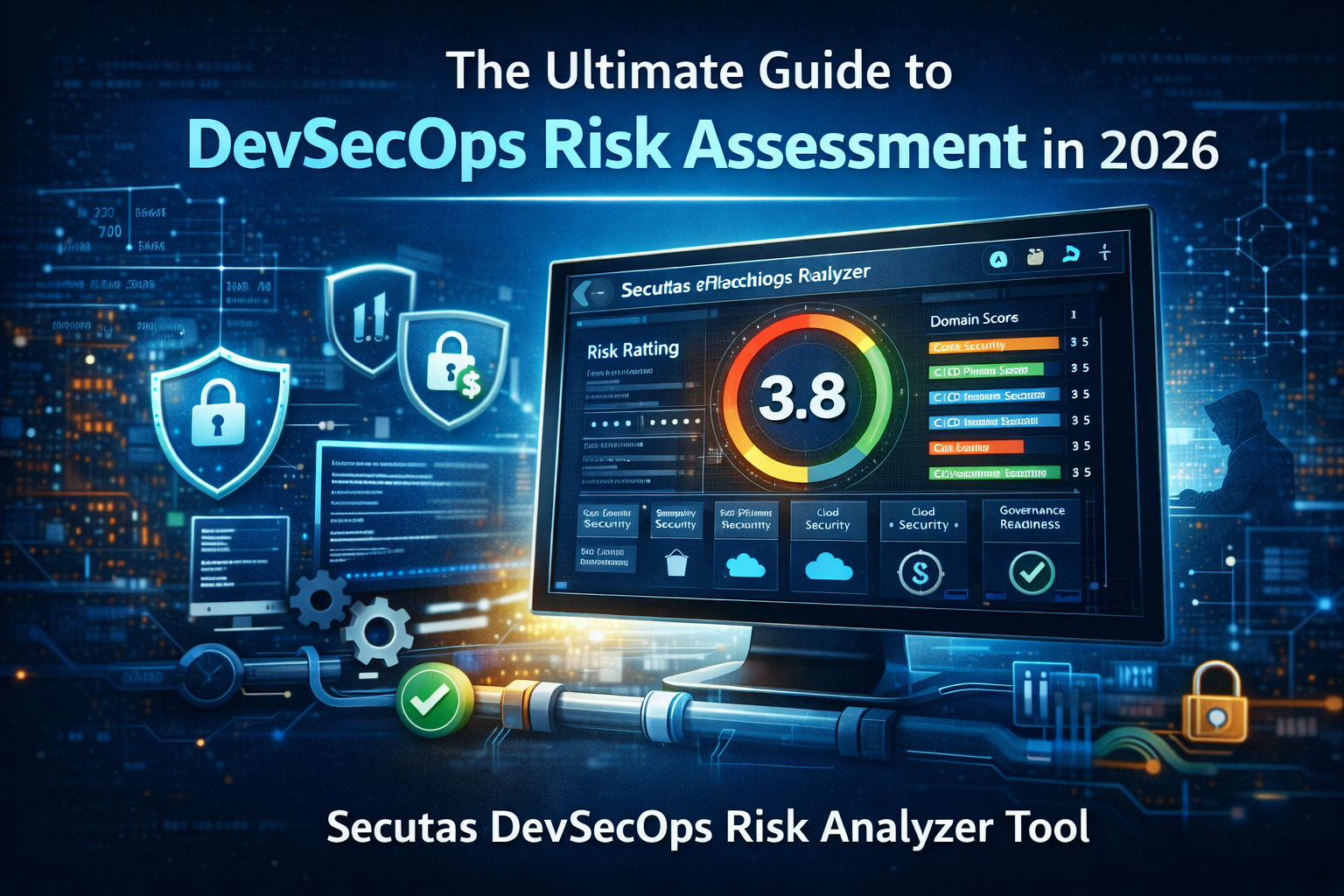
Introduction: DevSecOps Has Evolved
Over the past decade, DevOps has dramatically accelerated how software is built and deployed. Automation, CI/CD pipelines, containerization, and cloud-native infrastructure have enabled organizations to ship faster than ever before. But speed without embedded security introduces systemic risk.
That’s where DevSecOps emerged — not as a tool, but as a mindset. It integrates security directly into development and operations so that protection is continuous, automated, and measurable.
Yet here’s the uncomfortable truth: many organizations say they practice DevSecOps, but very few can clearly measure how mature their security controls actually are.
They run vulnerability scans.
They perform penetration tests.
They maintain compliance checklists.
All of that is useful. But none of it answers the strategic question leadership teams should be asking:
How resilient is our DevSecOps system as a whole?
This is the gap the Secutas DevSecOps Risk Analyzer is designed to address — by shifting the focus from isolated vulnerabilities to measurable control maturity.
Why Traditional Security Metrics Fall Short
Modern application environments are significantly more complex than they were five years ago. Organizations now rely on:
- Cloud-native infrastructure
- Containers and Kubernetes orchestration
- Infrastructure-as-Code (IaC)
- Microservices architectures
- Extensive open-source dependency chains
- Automated CI/CD pipelines
In this environment, risk rarely comes from a single coding flaw. It emerges from structural weaknesses:
- Over-permissive IAM roles
- Inconsistent secrets management
- Weak pipeline isolation
- Missing artifact validation
- Poor governance oversight
Even advanced security tools cannot compensate for immature processes. An organization might scan every commit, but if access control is inconsistent or pipeline credentials are poorly managed, the attack surface remains wide.
Security posture is not defined by how many vulnerabilities you detect.
It is defined by how mature and consistently enforced your controls are.
What Is DevSecOps Risk Assessment?
DevSecOps risk assessment is a structured evaluation of security maturity across the entire software delivery lifecycle.
Unlike a vulnerability assessment, which identifies technical defects, a DevSecOps maturity assessment evaluates:
- Process consistency
- Control enforcement
- Automation coverage
- Governance alignment
- Monitoring effectiveness
- Incident response readiness
It asks questions such as:
- Are our CI/CD pipelines hardened against compromise?
- Are supply chain risks being systematically managed?
- Are cloud security controls enforced consistently across environments?
- Do we have measurable governance mechanisms?
This type of assessment provides executive-level visibility into systemic risk — not just technical noise.
Introducing the Secutas DevSecOps Risk Analyzer
The Secutas DevSecOps Risk Analyzer is a structured maturity-based framework designed to quantify DevSecOps security posture.
Instead of generating long vulnerability reports, it produces:
- Domain-level maturity scores
- A weighted overall risk rating
- Governance-level visibility
- Clear improvement pathways
It does not replace scanning tools. It complements them by measuring something they cannot — systemic security maturity.
The framework evaluates five critical domains:
- Code Security
- Supply Chain & Dependency Security
- CI/CD Pipeline Security
- Cloud & Infrastructure Security
- Operational & Governance Readiness
Each domain is scored using a standardized maturity scale, enabling benchmarking across teams and business units.
The 0–5 Maturity Model Explained
At the core of the Secutas framework is a simple but powerful 0–5 maturity scale:
0 — Non-Existent: No formal controls in place.
1 — Initial: Reactive and inconsistent practices.
2 — Developing: Controls exist but with significant gaps.
3 — Defined: Documented and generally enforced controls.
4 — Managed: Consistent implementation with monitoring and metrics.
5 — Optimized: Fully automated, continuously improved, governance-aligned controls.
This structure makes maturity measurable and progress trackable.
Domain 1: Code Security Maturity
Secure code is the foundation of DevSecOps. Weak practices here introduce risk long before deployment.
The Risk Analyzer evaluates:
- SAST integration and enforcement
- Mandatory code reviews
- Secrets detection tools
- Branch protection policies
- Secure coding standards adoption
A maturity score below Level 3 often indicates inconsistent enforcement or a lack of automation within developer workflows.
Domain 2: Supply Chain & Dependency Security
Modern software depends heavily on third-party libraries. Supply chain attacks have shown how vulnerable open-source dependencies can become entry points for major breaches.
This domain assesses:
- Software Composition Analysis (SCA) coverage
- SBOM generation practices
- Dependency remediation timelines
- Repository integrity controls
- Automated update governance
Because supply chain weaknesses can cascade across systems, this domain carries substantial strategic importance.
Domain 3: CI/CD Pipeline Security
CI/CD pipelines are powerful — and highly sensitive. If compromised, they can push malicious code directly into production.
The framework evaluates:
- Pipeline isolation controls
- Artifact signing and validation
- Credential management practices
- Role-based access enforcement
- Logging and audit traceability
A mature CI/CD environment minimizes privilege exposure and ensures traceability across the deployment lifecycle.
Domain 4: Cloud & Infrastructure Security
Cloud misconfigurations remain one of the most common causes of data breaches. DevSecOps maturity must extend beyond code into infrastructure governance.
Assessment criteria include:
- Least-privilege IAM enforcement
- Encryption standards implementation
- IaC scanning integration
- Container image security controls
- Monitoring and logging consistency
Strong cloud maturity reflects disciplined policy enforcement across dynamic environments.
Domain 5: Operational & Governance Readiness
Even strong technical controls can fail without operational discipline. Governance ensures controls are sustained, monitored, and improved.
This domain evaluates:
- Incident response preparedness
- Patch management cadence
- Backup and disaster recovery validation
- Security monitoring coverage
- Executive oversight mechanisms
Organizations often discover that governance gaps — not technical flaws — create their greatest risk exposure.
Why Weighted Risk Modeling Matters
Not all security domains carry equal risk. A compromised CI/CD pipeline can have organization-wide impact. A cloud IAM misconfiguration can expose sensitive data at scale. Weak governance can delay detection and amplify damage.
The Secutas DevSecOps Risk Analyzer applies weighted scoring to reflect real-world impact rather than treating all domains equally.
This ensures the overall risk rating accurately represents strategic exposure.
The Strategic Importance of DevSecOps Maturity Assessment
Executive Visibility
Leadership teams need clear, measurable security indicators. Domain scores translate technical posture into governance language.
Compliance Alignment
Frameworks such as ISO 27001 and SOC 2 emphasize control maturity and governance consistency. A structured DevSecOps assessment strengthens audit readiness.
Smarter Investment Decisions
Quantified maturity gaps help organizations prioritize budget allocation where risk is highest.
Continuous Improvement
Repeated assessments allow organizations to measure progress over time and demonstrate security evolution.
Moving From Reactive to Governance-Driven Security
Traditional security programs focus on finding and fixing vulnerabilities. Modern DevSecOps focuses on preventing systemic weaknesses before they become incidents.
The Secutas DevSecOps Risk Analyzer supports this transition by:
- Measuring structural control maturity
- Highlighting governance gaps
- Providing prioritized remediation guidance
- Enabling cross-team benchmarking
This reflects a shift toward proactive security posture management.
Why This Matters in 2026
As organizations expand into microservices, hybrid cloud, API-driven architectures, and containerized ecosystems, complexity increases exponentially.
Without structured maturity measurement, organizations risk:
- Inconsistent control enforcement
- Hidden supply chain exposure
- Over-permissive access models
- Reactive, uncoordinated incident response
A repeatable, measurable DevSecOps risk assessment framework is essential to managing this complexity responsibly.
Conclusion: Building Sustainable DevSecOps Security
Security maturity is not a checkbox — it is a continuous discipline. Organizations that treat DevSecOps as a governance-driven framework rather than a collection of tools gain long-term resilience.
The Secutas DevSecOps Risk Analyzer provides:
- Domain-based maturity scoring
- Weighted overall risk evaluation
- Clear executive visibility
- Actionable improvement guidance
In today’s evolving threat landscape, structured DevSecOps risk assessment is no longer optional. It is foundational to sustainable, secure digital growth.
Organizations that measure maturity today will be significantly better prepared for the risks of tomorrow.
Leave a Reply