
Modern Security Operations Centers (SOCs) operate in a high-noise, high-stakes environment. Analysts are expected to triage dozens—sometimes hundreds—of alerts daily, each potentially representing a real threat to business operations. The challenge is not merely detecting malicious activity; it is classifying it accurately, responding proportionally, and documenting it rigorously. Inconsistent severity ratings, vague containment plans, and incomplete documentation can create operational risk, compliance gaps, and unnecessary escalation overhead.
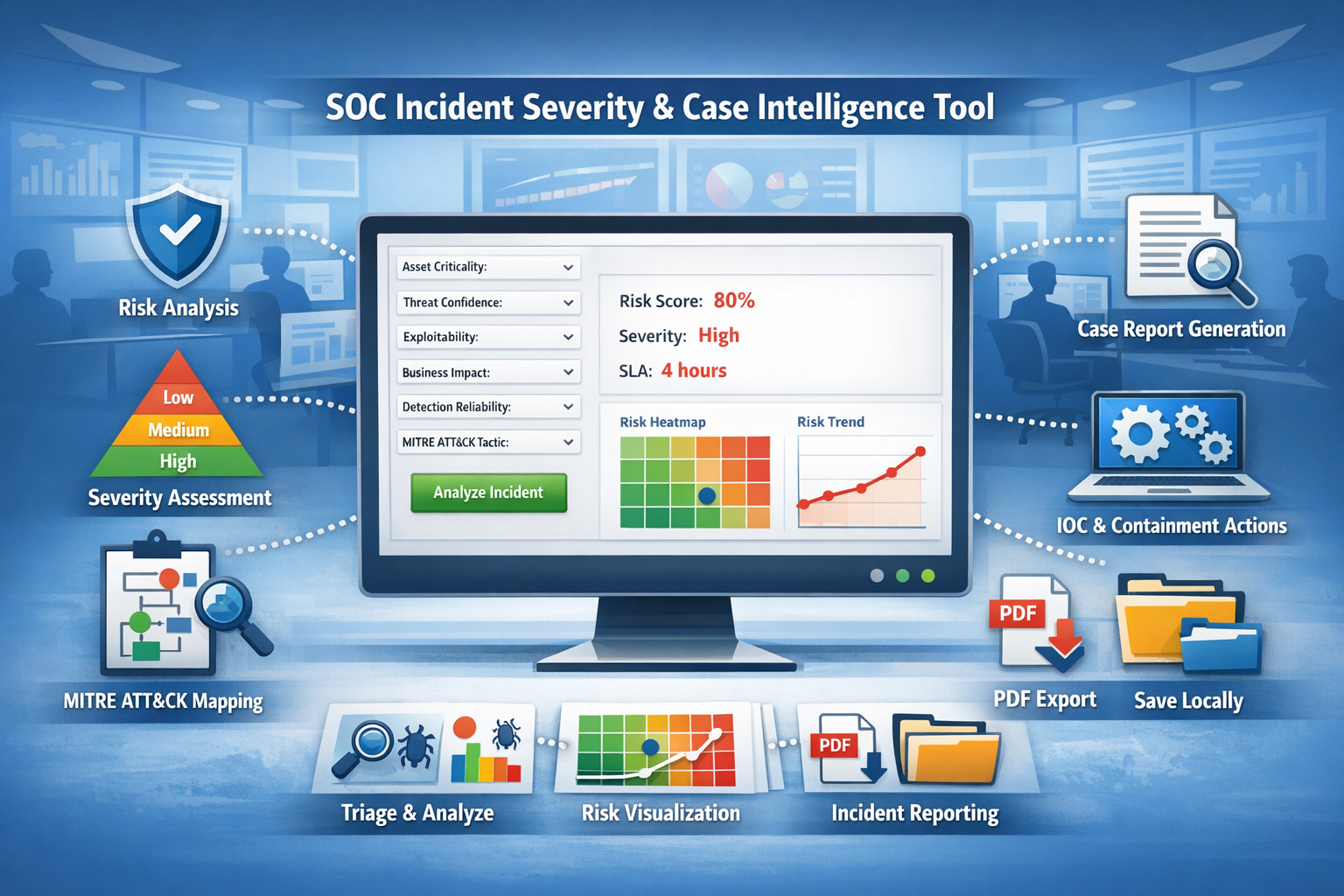
The Incident Severity & Case Intelligence Tool was designed to address exactly these challenges. It provides a structured, defensible framework for incident triage while simultaneously generating actionable intelligence outputs such as MITRE ATT&CK mapping, risk heatmaps, case documentation templates, and exportable reports. The objective is simple: transform alert analysis from subjective judgment into a standardized, auditable, and scalable workflow.
The Problem with Traditional Triage
In many SOC environments, severity classification is still partially subjective. Two analysts reviewing the same alert might assign different priority levels based on experience, intuition, or workload pressure. This variability introduces several issues:
- Inconsistent SLAs
- Delayed response to high-risk incidents
- Over-escalation of low-risk alerts
- Weak audit defensibility
- Poor reporting clarity for management
Moreover, incident documentation often happens as an afterthought. Analysts focus on containment and eradication, and documentation becomes rushed, incomplete, or non-standardized. When compliance teams, auditors, or leadership request reporting artifacts, the SOC must reconstruct timelines retroactively.
The Incident Severity & Case Intelligence Tool addresses these pain points by combining structured scoring logic with automated documentation generation.
A Structured Risk-Based Scoring Model
At its core, the tool operates on a weighted risk model. Rather than relying on intuition alone, it evaluates incidents based on measurable parameters:
- Asset Criticality (1–5)
- Threat Confidence
- Exploitability
- Business Impact
- Detection Source Reliability
- MITRE ATT&CK Tactic
Each factor contributes to a composite risk score. Asset criticality reflects the importance of the affected system. Threat confidence measures how certain we are that the activity is malicious. Exploitability assesses how easily the vulnerability or attack vector can be leveraged. Business impact quantifies potential operational, financial, or reputational damage. Detection source reliability distinguishes between high-confidence telemetry (e.g., EDR detections) and lower-confidence sources.
By combining these inputs using weighted logic, the system calculates a numerical risk score. This score is then mapped to a standardized severity rating:
- Low
- Medium
- High
- Critical
This structured methodology reduces ambiguity and ensures that two analysts evaluating similar conditions reach comparable conclusions.
Automated SLA Recommendations
Severity classification alone is not enough. Operational efficiency requires clearly defined response timelines.
Once the severity is determined, the tool automatically assigns a recommended Service Level Agreement (SLA). For example:
- Low: 72 hours
- Medium: 24 hours
- High: 4–8 hours
- Critical: Immediate response
This eliminates confusion during shift transitions and reinforces consistent operational expectations. It also supports performance metrics tracking and audit defensibility.
Dynamic Risk Heatmap Visualization
Visualization is a powerful operational aid. The dynamic risk heatmap transforms abstract risk calculations into an intuitive graphical representation.
By plotting asset criticality against exploitability or business impact, the heatmap provides a visual snapshot of risk posture. Analysts can immediately see whether an incident falls into a low-risk quadrant or a high-risk, high-impact zone requiring urgent containment.
For SOC managers, the heatmap serves as a communication bridge between technical teams and executive stakeholders. Risk is no longer described abstractly—it is visualized in a way that aligns with enterprise risk management frameworks.
Risk Trend Tracking Over Time
Incidents rarely exist in isolation. Trends matter.
The tool includes a risk trend visualization feature that tracks calculated risk scores over time. This capability enables:
- Detection of increasing attack sophistication
- Identification of recurring vulnerable assets
- Pattern recognition in threat actor behavior
- Quantification of SOC performance improvements
By analyzing trend data, organizations can move from reactive defense toward proactive risk management.
MITRE ATT&CK Mapping for Contextual Intelligence
One of the most valuable enhancements is integrated MITRE ATT&CK mapping.
Each incident can be mapped to a relevant tactic such as Initial Access, Execution, Persistence, Privilege Escalation, Defense Evasion, Credential Access, Discovery, Lateral Movement, Command and Control, or Impact. This provides structured context aligned with the globally recognized MITRE framework.
Mapping incidents to ATT&CK tactics offers multiple advantages:
- Improved threat intelligence correlation
- Standardized reporting language
- Enhanced detection engineering insights
- Gap analysis in defensive controls
This approach aligns the SOC workflow with industry best practices and elevates the maturity of incident reporting.
Auto-Generated Indicators of Compromise (IOCs)
Documentation is often incomplete because analysts must manually compile technical artifacts. The tool streamlines this by auto-generating suggested Indicators of Compromise based on the selected attack tactic and incident attributes.
Examples of generated IOCs may include:
- Suspicious IP addresses
- Malicious domain patterns
- Hash artifacts
- Unusual process executions
- Registry modifications
- Persistence mechanisms
These IOCs can be refined by analysts before inclusion in the case documentation, ensuring accuracy while reducing effort.
Intelligent Containment Recommendations
Containment actions must be both immediate and proportional to risk.
The tool automatically suggests containment workflows based on severity and attack category. For example:
- Isolate endpoint from network
- Disable compromised accounts
- Block malicious IP/domain at firewall
- Reset credentials
- Apply patches
- Initiate forensic imaging
This guided response framework helps junior analysts act confidently while reinforcing standardized response playbooks.
Case Documentation Template Generation
Perhaps one of the most operationally impactful features is structured case documentation generation.
Upon analysis, the tool produces a formatted incident report template that includes:
- Incident Summary
- Risk Score & Severity
- SLA Recommendation
- MITRE ATT&CK Tactic
- Indicators of Compromise
- Containment Actions
- Response Workflow
- Timeline Section
This ensures that every case file follows a consistent, professional format. For SOC students and training environments, this also reinforces proper reporting discipline.
PDF Export and Archiving
Operational workflows frequently require exporting reports for management review, client communication, or audit purposes.
The one-click PDF export feature allows analysts to generate clean, shareable reports instantly. This removes friction from escalation workflows and supports compliance documentation requirements.
Additionally, reports can be saved to a database or local storage, enabling case history tracking and future analysis.
A Learning Platform for SOC Students
Beyond enterprise deployment, the tool serves as a powerful educational platform.
SOC students often struggle to understand how theoretical risk concepts translate into operational decisions. By inputting parameters and observing calculated outcomes, learners gain practical insight into:
- Risk scoring logic
- Severity classification
- SLA prioritization
- ATT&CK mapping
- Structured documentation
This bridges the gap between academic knowledge and real-world SOC processes.
Operational Benefits
From a business perspective, the Incident Severity & Case Intelligence Tool delivers measurable advantages:
- Reduced subjectivity in triage
- Faster decision-making
- Improved documentation quality
- Enhanced audit readiness
- Standardized escalation processes
- Improved management visibility
By embedding structure into triage workflows, the SOC becomes more predictable, scalable, and defensible.
Aligning SOC and GRC Objectives
The tool also supports Governance, Risk, and Compliance (GRC) objectives.
Because incidents are scored using defined criteria, organizations can demonstrate risk-based decision-making during audits. Severity assignments are no longer arbitrary; they are traceable to documented inputs.
Furthermore, MITRE mapping enhances control gap identification, supporting broader risk management initiatives.
Bridging Technical and Executive Communication
One of the persistent challenges in cybersecurity is translating technical findings into business language.
By combining severity ratings, SLAs, visual heatmaps, and structured documentation, the tool creates artifacts that are understandable at both technical and executive levels. This strengthens trust between the SOC and leadership.
Moving Toward Intelligent SOC Automation
While not a replacement for analyst judgment, this tool represents a step toward intelligent SOC augmentation.
It reduces cognitive load, accelerates documentation, standardizes response, and improves visibility. Analysts remain central decision-makers, but they operate within a structured framework that enhances accuracy and consistency.
Future enhancements could include:
- Machine learning–based risk weighting
- Threat intelligence feed integration
- Automated IOC enrichment
- API-based ticketing system integration
- Dashboard-level SOC metrics reporting
Conclusion
The Incident Severity & Case Intelligence Tool is more than a calculator. It is a structured operational framework for modern security teams.
By integrating risk scoring, SLA assignment, heatmap visualization, MITRE ATT&CK mapping, automated IOC suggestions, containment workflows, documentation templates, PDF export, and trend tracking, it transforms incident triage into a disciplined, repeatable process.
In a cybersecurity landscape defined by speed and complexity, precision and structure are competitive advantages. This tool empowers SOC teams to move from reactive alert handling to strategic, risk-informed decision-making—while ensuring every incident is documented, defensible, and aligned with best practices.
For SOC analysts, blue teamers, educators, and cybersecurity organizations seeking maturity, this approach represents a practical and scalable evolution in incident response operations.
Try the Incident Severity & Case Intelligence Tool
If you are a SOC analyst, blue team professional, cybersecurity student, or security leader looking to bring structure and clarity to incident triage, we invite you to experience the tool firsthand.
Our Incident Severity & Case Intelligence Tool is designed to help you classify alerts accurately, generate standardized documentation, visualize risk through heatmaps and trends, and align your investigations with MITRE ATT&CK — all in one streamlined workflow.
Start using the tool here:
👉 Access the Tool Now:
https://secutas.in/the-soc-incident-severity-case-intelligence-tool/
Whether you are training, building your SOC processes, or strengthening operational maturity, this platform is built to support real-world security operations with practical, structured intelligence.
We welcome your feedback as we continue enhancing the platform to support modern security teams.
Leave a Reply