

As cyber threats continue to escalate in frequency, sophistication, and impact, organizations are increasingly realizing that traditional approaches to cybersecurity risk assessment are no longer sufficient. Board members and executives are no longer satisfied with abstract labels such as “high risk” or color-coded heat maps that lack financial meaning. They want to understand cyber risk in the same language used to evaluate other business risks: money, probability, and impact. This is where Cyber Risk Quantification (CRQ) and the FAIR model come into focus.
FAIR, which stands for Factor Analysis of Information Risk, provides a structured, quantitative approach to analyzing and expressing cyber risk in financial terms. Rather than relying on subjective scoring, FAIR enables organizations to estimate how often a cyber event might occur and how much it could cost if it does. This shift fundamentally changes how cybersecurity is discussed, prioritized, and governed at the executive level.
What Is FAIR?
FAIR is an open, internationally recognized model for quantifying information risk. It was designed to bring rigor, consistency, and transparency to cyber risk analysis by defining risk using measurable components. The model is maintained and promoted by the FAIR Institute and is aligned with established risk management standards such as ISO/IEC 27005.
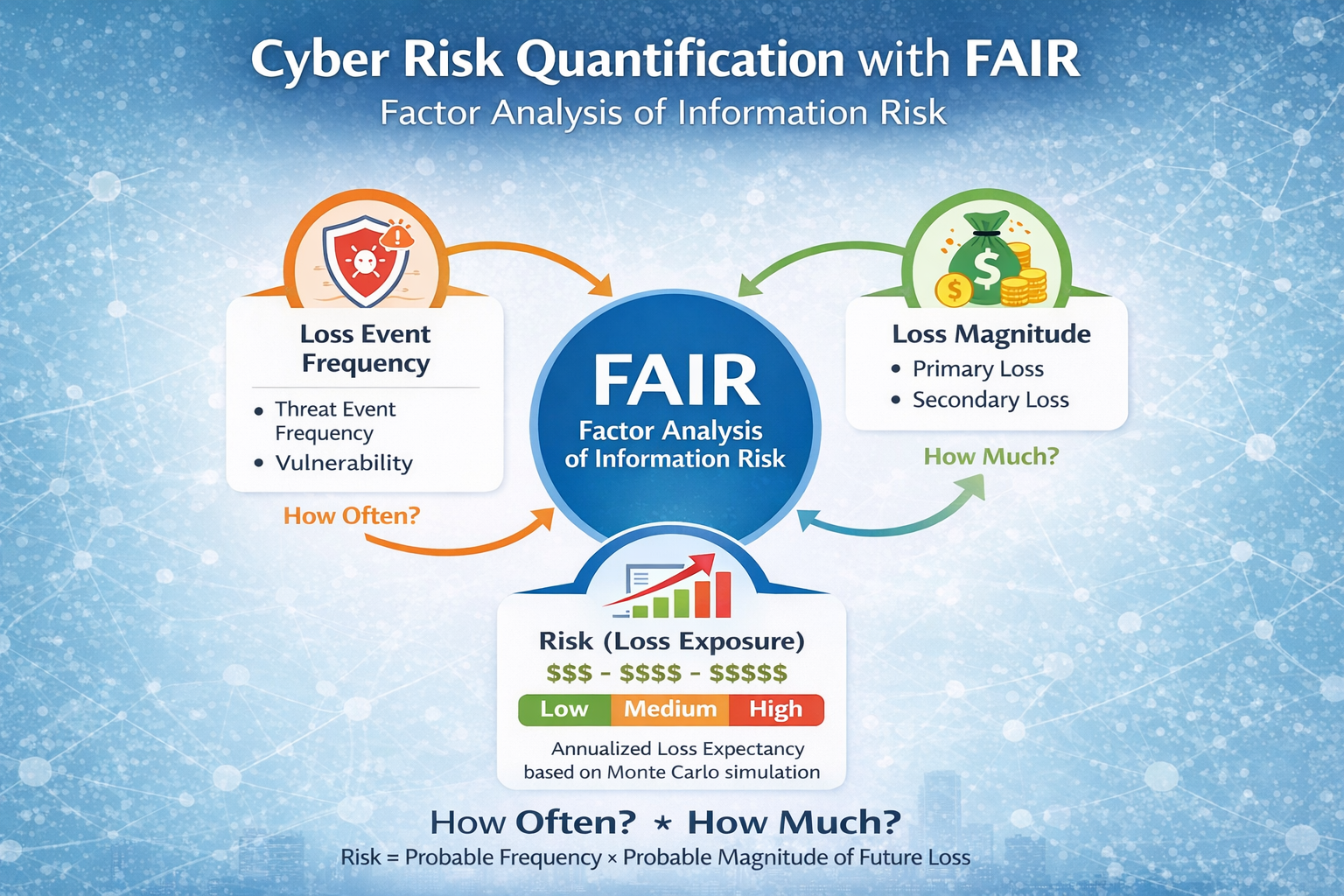
At its core, FAIR defines risk as the probable frequency and probable magnitude of future loss. This definition is deceptively simple, but it represents a major departure from traditional cybersecurity risk approaches. Instead of asking whether a risk is “high” or “low,” FAIR asks two far more meaningful questions: How often could a loss occur, and how severe could that loss be? By answering these questions quantitatively, organizations gain a far clearer understanding of their true exposure.
Why Traditional Cyber Risk Methods Fall Short
Most organizations today still rely on qualitative or semi-quantitative risk assessment methods. These approaches often involve assigning numerical values to likelihood and impact, multiplying them together, and categorizing the result into a risk tier. While this method is easy to understand and quick to implement, it suffers from serious limitations.
First, qualitative scoring is inherently subjective. Two analysts assessing the same scenario may arrive at very different conclusions, making results difficult to compare or defend. Second, heat maps and ordinal scales create an illusion of precision without delivering actionable insight. A “high” risk could mean a potential loss of $50,000 or $50 million, yet both are treated the same. Finally, these methods do little to support rational decision-making when it comes to prioritizing investments or comparing cyber risk to other enterprise risks.
FAIR addresses these shortcomings by replacing subjective labels with probabilistic and financial analysis. It does not eliminate uncertainty, but it makes uncertainty explicit, measurable, and manageable.
The FAIR Risk Model Explained
The strength of FAIR lies in its structured decomposition of risk into clearly defined components. Rather than treating risk as a single abstract concept, FAIR breaks it down into factors that can be estimated, analyzed, and refined over time.
The model begins with Loss Event Frequency (LEF), which represents how often a loss event is expected to occur. LEF is derived from two underlying factors: Threat Event Frequency and Vulnerability. Threat Event Frequency captures how often a threat agent is likely to act against an asset, while Vulnerability represents the probability that those actions will result in loss, given the strength of existing controls and the capability of the threat.
The second major component is Loss Magnitude (LM), which represents the financial impact of a loss event if it occurs. FAIR further divides loss magnitude into primary and secondary losses. Primary losses include direct costs such as incident response, system restoration, productivity loss, and business interruption. Secondary losses capture downstream effects such as regulatory fines, legal action, reputational damage, and customer churn.
By combining Loss Event Frequency and Loss Magnitude, FAIR produces a loss distribution that shows a range of possible financial outcomes and their probabilities. This is a far more realistic representation of risk than a single score or category.
From Scenarios to Financial Insight
FAIR is typically applied using a scenario-based approach. Rather than attempting to quantify all cyber risk at once, organizations focus on specific, well-defined scenarios. For example, a scenario might examine the financial risk associated with ransomware targeting critical systems, or the impact of a third-party data breach involving sensitive customer information.
Each scenario is analyzed by estimating the relevant FAIR factors using available data, expert judgment, and industry benchmarks. These estimates are then modeled, often using Monte Carlo simulations, to produce a range of potential outcomes. The result is not a single number, but a probabilistic view of risk that reflects real-world uncertainty.
This approach allows organizations to compare scenarios directly, prioritize remediation efforts, and evaluate the financial return on security investments. It also makes assumptions explicit, enabling continuous improvement as better data becomes available.
The Business Value of FAIR
One of the most significant advantages of FAIR is its ability to align cybersecurity with business decision-making. By expressing risk in financial terms, FAIR enables security leaders to communicate effectively with executives, boards, and financial stakeholders. Conversations shift from technical vulnerabilities to economic exposure and risk appetite.
FAIR also supports cost-benefit analysis. Security controls are no longer justified solely on the basis of best practice or compliance, but on their ability to reduce expected loss. This makes it possible to answer critical questions such as whether investing in a new security control will reduce risk more effectively than alternative investments.
In addition, FAIR improves consistency and defensibility. Because the model is structured and transparent, risk assessments can be repeated, compared, and audited. This is particularly valuable in regulated industries and during cyber insurance negotiations.
FAIR and Regulatory Alignment
While FAIR is not a compliance framework, it complements regulatory and standards-based approaches extremely well. Many organizations use FAIR alongside frameworks such as ISO 27001, NIST, or sector-specific regulations. In this context, compliance requirements help identify what controls should exist, while FAIR helps quantify the financial risk associated with control gaps.
This combination allows organizations to move beyond a “check-the-box” mindset and focus on reducing the most significant sources of risk. It also provides a strong foundation for demonstrating due diligence to regulators and auditors, as risk decisions are backed by structured analysis rather than intuition.
Challenges and Misconceptions
Despite its benefits, FAIR adoption is not without challenges. One common misconception is that FAIR requires perfect data to be effective. In reality, FAIR is designed to work with imperfect information by using ranges and probability distributions. The goal is not precision, but decision-quality insight.
Another challenge is the learning curve. FAIR introduces new concepts and requires training to apply correctly. Organizations may initially struggle with estimation techniques and scenario definition. However, most teams find that proficiency improves rapidly with practice, and the long-term benefits far outweigh the initial investment.
Cultural resistance can also be a barrier. Moving from qualitative judgments to quantitative analysis requires a shift in mindset, particularly for teams accustomed to traditional risk scoring. Executive sponsorship and clear communication are critical to overcoming this resistance.
FAIR as a Strategic Capability
Organizations that successfully adopt FAIR often find that it becomes more than just a risk assessment tool. It evolves into a strategic capability that informs budgeting, enterprise risk management, and long-term planning. Cybersecurity is no longer viewed as a cost center, but as a risk management function that protects and enables business value.
FAIR also supports maturity over time. Early analyses may rely heavily on expert judgment, but as organizations collect incident data and refine their models, accuracy and confidence improve. This iterative approach aligns well with modern, data-driven governance practices.
Conclusion
FAIR represents a significant advancement in how organizations understand and manage cyber risk. By defining risk in terms of probable frequency and financial impact, it bridges the gap between technical security concerns and business decision-making. In an environment where cyber threats pose material risks to revenue, reputation, and operations, this alignment is no longer optional.
While FAIR does not eliminate uncertainty, it provides a structured, defensible way to navigate it. For organizations seeking to move beyond subjective risk scoring and toward economically rational security decisions, FAIR offers a proven and practical path forward.


Leave a Reply