

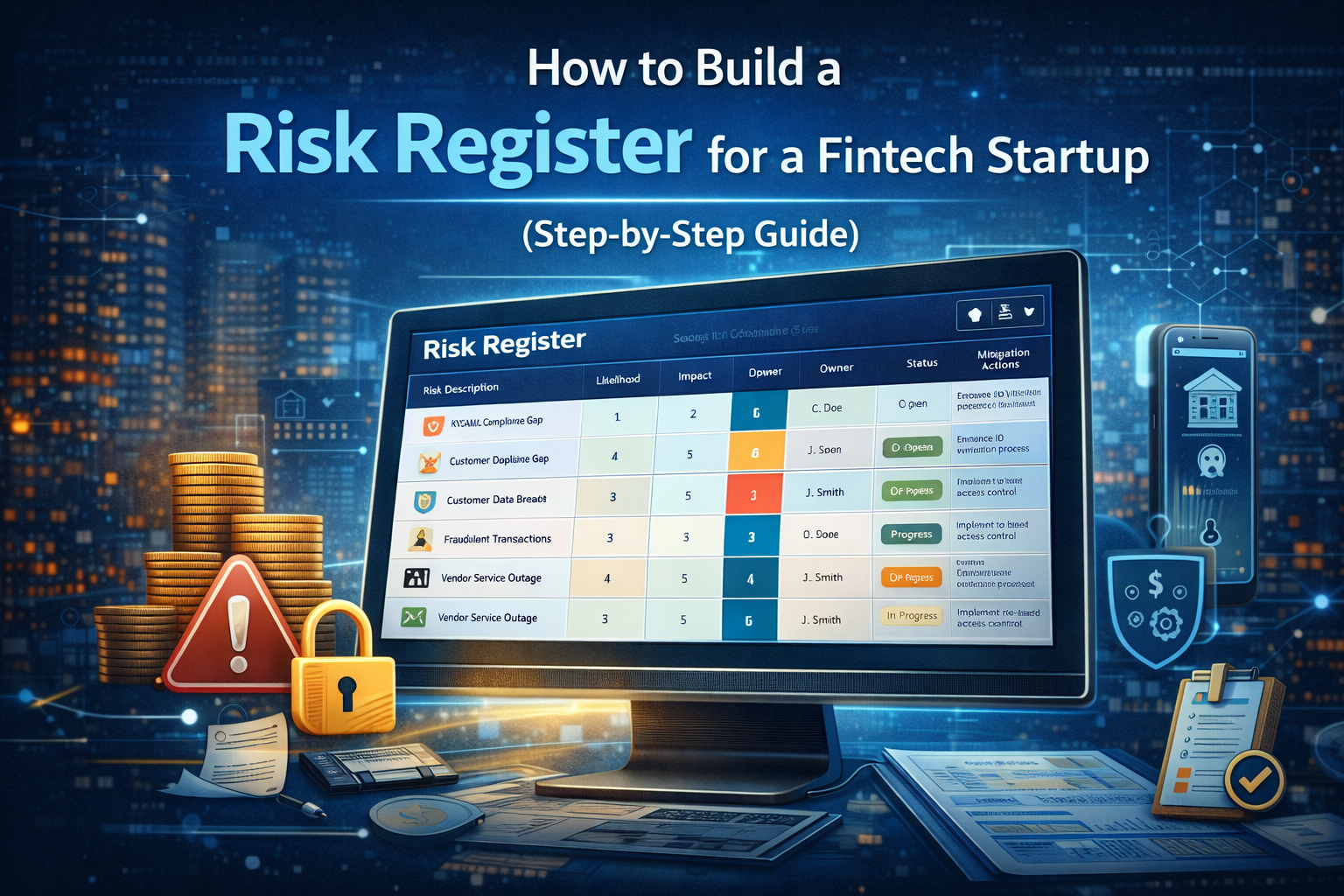
Introduction: Why Fintech Risk Management Cannot Be an Afterthought
Fintech startups operate in one of the most complex and highly regulated environments in the digital economy. Unlike traditional SaaS businesses, fintech platforms manage money flows, sensitive financial data, payment integrations, identity verification processes, and regulatory obligations simultaneously. A single overlooked risk can lead to regulatory penalties, reputational damage, or customer trust erosion — outcomes that early-stage companies may not survive.
In this environment, informal risk tracking in spreadsheets or ad hoc discussions is not sufficient. Fintech founders and security leaders need structured visibility into operational, technical, regulatory, and strategic risks. This is where a properly designed risk register becomes essential.
A risk register is not just a compliance document. When built correctly, it becomes a live decision-making tool that helps leadership prioritize mitigation efforts, allocate budget effectively, and demonstrate governance maturity to investors, regulators, and banking partners.
This guide provides a step-by-step framework to help fintech startups build a practical, scalable risk register that supports secure growth.
What Is a Risk Register — and Why It Matters in Fintech
A risk register is a centralized, structured record of identified risks, their likelihood and impact, ownership, mitigation strategies, and current status. It provides visibility into threats that could affect business objectives.
For fintech startups, risks typically fall into multiple domains:
- Regulatory and compliance risks
- Cybersecurity and data protection risks
- Operational and process risks
- Third-party and vendor risks
- Financial and liquidity risks
- Fraud and abuse risks
- Reputational risks
Unlike traditional industries, fintech combines technology risk with financial risk and regulatory scrutiny. Therefore, a risk register must integrate technical and governance considerations into a unified view.
A mature risk register answers three critical questions:
- What can go wrong?
- How severe would the impact be?
- What are we doing about it — and who owns it?
Without documented risk ownership and mitigation planning, risk management remains reactive.
Step 1: Define Risk Governance and Ownership
Before documenting risks, establish governance structure. Even early-stage fintech startups must assign accountability.
At minimum, define:
- Risk Owner (business-level accountability)
- Risk Manager or Security Lead (coordination and tracking)
- Executive Oversight (founder, CTO, or COO)
Risk ownership should be explicit. A risk without an owner is a risk that will not be mitigated.
For startups under regulatory oversight (for example, those working with banking partners or payment processors), demonstrating formal risk governance builds credibility and strengthens audit readiness.
Step 2: Identify Risk Categories Relevant to Fintech
Fintech risk identification must go beyond generic cybersecurity threats. Use structured brainstorming sessions across technical, compliance, and operations teams.
Key fintech-specific risk categories include:
Regulatory & Compliance Risk
- Non-compliance with KYC/AML requirements
- Inadequate data protection controls
- Failure to meet financial reporting standards
- Cross-border regulatory exposure
Regulatory failure can result in fines, license suspension, or forced shutdown.
Cybersecurity Risk
- Data breach involving PII or financial data
- Account takeover attacks
- API exploitation
- Ransomware affecting payment infrastructure
Fintech platforms are high-value targets due to financial incentives.
Fraud Risk
- Synthetic identity fraud
- Transaction laundering
- Insider abuse
- Payment fraud schemes
Fraud risk is operationally intertwined with financial exposure.
Third-Party Risk
- Payment gateway outages
- Cloud service disruptions
- Vendor data handling weaknesses
- Dependency on external compliance platforms
Fintech startups often rely heavily on partners; concentration risk must be evaluated.
Operational Risk
- Deployment errors impacting transaction accuracy
- Inadequate reconciliation processes
- Business continuity gaps
- Key personnel dependency
Operational weaknesses can trigger cascading financial consequences.
Each risk identified should be written clearly, describing the scenario and potential consequence.
Step 3: Write Risks Clearly and Specifically
A common mistake in risk registers is vague language. Avoid generic entries like:
“Cybersecurity risk.”
Instead, document risks using structured statements:
“If unauthorized access to customer transaction data occurs due to weak access control enforcement, the company may face regulatory fines and reputational damage.”
Each risk statement should include:
- Risk event
- Root cause or vulnerability
- Business impact
Clear documentation improves risk scoring accuracy and mitigation planning.
Step 4: Assess Likelihood and Impact
Once risks are identified, evaluate them systematically.
Likelihood
Estimate how probable the risk is, using a consistent scale (e.g., 1–5):
1 – Rare
2 – Unlikely
3 – Possible
4 – Likely
5 – Almost Certain
Likelihood should be based on evidence such as historical incidents, industry trends, control maturity, and threat intelligence.
Impact
Impact should reflect business consequences:
1 – Minimal operational disruption
2 – Limited financial loss
3 – Moderate financial or reputational damage
4 – Significant regulatory or operational impact
5 – Severe regulatory action or existential threat
For fintech startups, regulatory impact often carries higher weighting than technical inconvenience.
Multiply likelihood and impact to calculate inherent risk score. This allows prioritization.
Step 5: Identify Existing Controls
After calculating inherent risk, document current mitigation controls.
For example:
Risk: API abuse leading to unauthorized transactions.
Existing Controls:
- Rate limiting
- Authentication enforcement
- Web Application Firewall (WAF)
- Monitoring alerts
Documenting controls enables assessment of residual risk (risk remaining after mitigation).
Residual risk should be recalculated based on control effectiveness.
Step 6: Assign Risk Owners and Mitigation Actions
Every risk must have:
- Named owner
- Target mitigation actions
- Clear timeline
- Status (Open, In Progress, Mitigated, Accepted)
Example:
Risk Owner: Head of Engineering
Mitigation Action: Implement role-based access control enforcement and quarterly access reviews
Target Date: Q2 2026
Accountability transforms the risk register from documentation into execution.
Step 7: Define Risk Appetite and Acceptance Criteria
Not all risks can be eliminated. Startups operate under resource constraints and must balance innovation with control.
Define risk appetite formally:
- What level of financial exposure is acceptable?
- What regulatory risks are non-negotiable?
- Which risks require immediate escalation?
Risk acceptance should require executive approval and documented rationale.
This demonstrates governance maturity to investors and auditors.
Step 8: Integrate Compliance Requirements
Fintech startups may be subject to:
- AML/KYC regulations
- Data protection laws
- Payment card standards
- Banking partnership security audits
Map risks to compliance controls.
For example:
Risk: Inadequate customer identity verification
Mapped Regulation: AML compliance requirement
Control: Enhanced due diligence workflow
Mapping risks to regulatory frameworks strengthens audit readiness and prevents compliance blind spots.
Step 9: Include Fraud and Financial Exposure Metrics
Fintech risk registers should integrate financial exposure quantification where possible.
For fraud-related risks:
- Estimate potential transaction loss
- Model exposure per incident
- Evaluate detection response time
Quantitative modeling strengthens prioritization and board-level reporting.
Step 10: Review and Update Regularly
A risk register is not static.
It should be reviewed:
- Quarterly at minimum
- After major product releases
- After incidents
- When entering new regulatory jurisdictions
Fintech startups evolve quickly. Risk profiles shift as features, markets, and integrations expand.
Continuous review prevents outdated risk assumptions.
Common Mistakes Fintech Startups Make
Many startups create risk registers only for compliance audits and then ignore them. This defeats the purpose.
Other common mistakes include:
- Treating cybersecurity as the only risk domain
- Failing to assign ownership
- Using inconsistent scoring methods
- Ignoring third-party risk
- Avoiding documentation of accepted risks
Risk transparency may feel uncomfortable, but it strengthens governance credibility.
How a Structured Risk Register Supports Investor Confidence
Investors evaluate fintech startups not only on growth potential but also on risk exposure.
A structured risk register demonstrates:
- Governance discipline
- Regulatory awareness
- Operational maturity
- Proactive security culture
For Series A and beyond, documented risk management becomes a differentiator.
Scaling the Risk Register as You Grow
As fintech startups mature, risk management must evolve.
Early stage: Spreadsheet-based tracking may suffice.
Growth stage: Centralized governance tools recommended.
Scale stage: Integration with GRC platforms and automated control monitoring.
Risk register maturity should evolve alongside DevSecOps and compliance maturity.
Final Thoughts: Risk Registers Enable Secure Innovation
Fintech innovation moves fast — but risk compounds just as quickly. Building a structured risk register is not about slowing down innovation. It is about protecting it.
A well-designed risk register provides:
- Clear risk visibility
- Prioritized mitigation planning
- Executive-level reporting
- Regulatory readiness
- Stronger investor confidence
Most importantly, it builds organizational discipline.
Risk management is not about eliminating uncertainty. It is about making informed decisions in the presence of uncertainty.
Fintech startups that adopt structured risk governance early position themselves for sustainable growth, stronger partnerships, and long-term credibility.
Secure innovation requires intentional risk management. A properly built risk register is where that discipline begins.

Leave a Reply